Disclosure: Some of the links in this post may contain affiliate links, so if you click on the link and purchase the item, I will receive a commission.
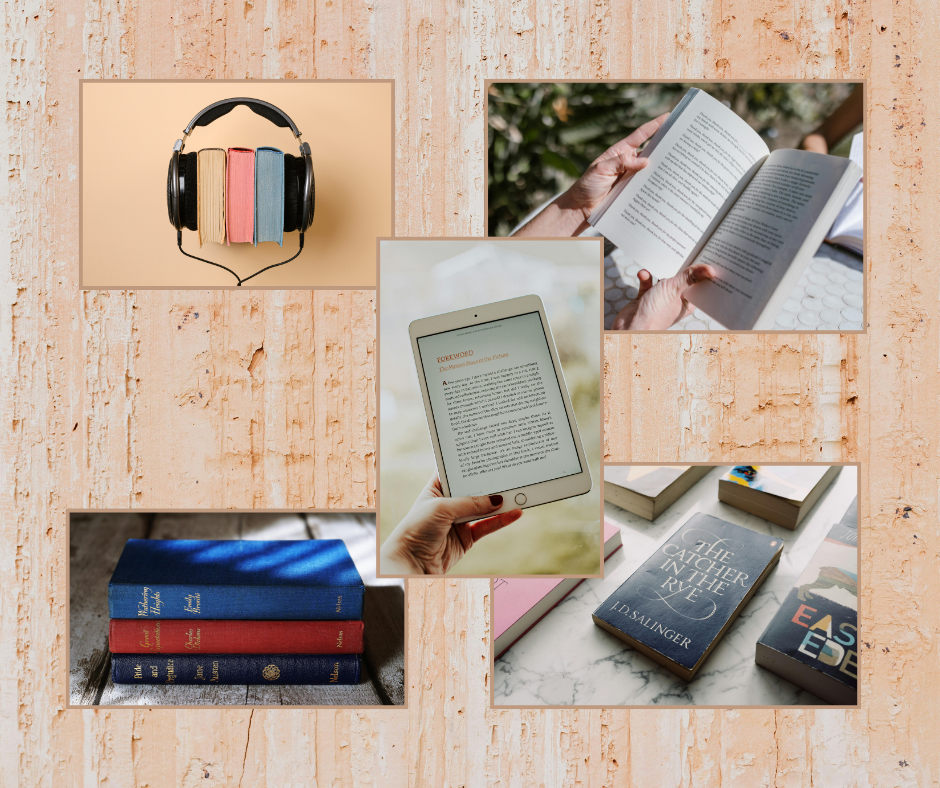
We live in a time where we have never had more books at our fingertips than at any point in history. Over 2.2 million new books are published worldwide every year (source ISBNdb), and the average American reads (or listens to) to about 12 books per year (source BookRiot). Books are everywhere – on shelves, on screens, and in our earbuds.
With so many options, readers today don’t just choose what to read – they choose how to read. Print books, eBooks, and audiobooks each offer a different experience—and most of us use more than one.
In this post, we’ll take a quick look at the history of the book, explore the most popular book formats, and break down the pros and cons of each so you can decide which format best fits your reading life.
A Very Brief History of the Book
The book format we recognize today – the codex – emerged around 300 BC (source Medium). Before that, written works were recorded on scrolls, which were bulky, fragile and difficult to reference. The codex made reading more practical and portable, and early Christians were quick to adopt it, helping spread the format as they circulated letters and texts amongst churches (source Aeon).
During the 18th century, novels exploded in popularity. Industrialization made books cheaper to produce, literacy rates rose, and the growing middle class suddenly had both leisure time and disposable income. For the first time, books were widely available to everyday people – not just scholars or the wealthy (source eNotes).
Types of Book Formats (Pros and Cons)
MASS MEDIA PAPERBACKS
Introduced in the 1930s, mass market paperbacks were designed to be affordable and portable – small enough to fit in a pocket or a purse.
Pros:
- Small and lightweight
- Affordable
- Easy to gift
- Can be shared, sold or donated
Cons:
- Lower quality paper and binding
- Small font size
TRADE PAPERBACKS
Trade paperbacks are larger and higher quality than mass market editions, typically measuring 5×8 inches or 6×9 inches.
Pros:
- Higher quality than mass media
- Easier to read and hold
- Easy to gift
- Can be shared, sold or donated
Cons:
- Not as durable as hardcovers
- Less portable than mass market paperback
HARDCOVERS (Hardbacks)
Hardcovers are often considered the most collectible and visually appealing book format.
Pros:
- Durable and long-lasting
- Beautiful cover designs
- Higher resale value
- Can be shared, sold or donated
Cons:
- Heavier and bulky to carry around
- More expensive than other formats
- Take up significant space when moving
- Often come with dust jackets (love them or hate them)
EBOOKS
Electronic books arrived in the 1990s, with the first digital text being the Declaration of Independence (source Book Scouter). Since then, eBooks have transformed how readers access books.
Pros:
- Space-saver
- Instantly accessible
- Extremely portable
- Adjustable font size and background
- Ideal for travel and night reading
Cons:
- Can’t be shared or re-sold easily
- Increased screen time
- Lacks the tactile experience of a physical book
AUDIOBOOKS
Audiobooks have been around since 1932, originally created to provide access for the visually impaired. Today, they are one of the fastest-growing reading formats.
Pros:
- Hands-free and portable
- Perfect for multi-tasking
- Great for commutes and road trips
- Budget-friendly via library apps
- Space-saver
- Increased accessibility for those with visual or learning disabilities
Cons:
- No exposure to spelling and grammar
- Technology-dependent
- Experience depends heavily on the narrator
- Less immersive for readers who love curling up with a book
💡For more on audiobooks, check out this post on how audiobooks fit into my life and this post on if audiobooks count as reading.
Which Book Format is the Most Popular?
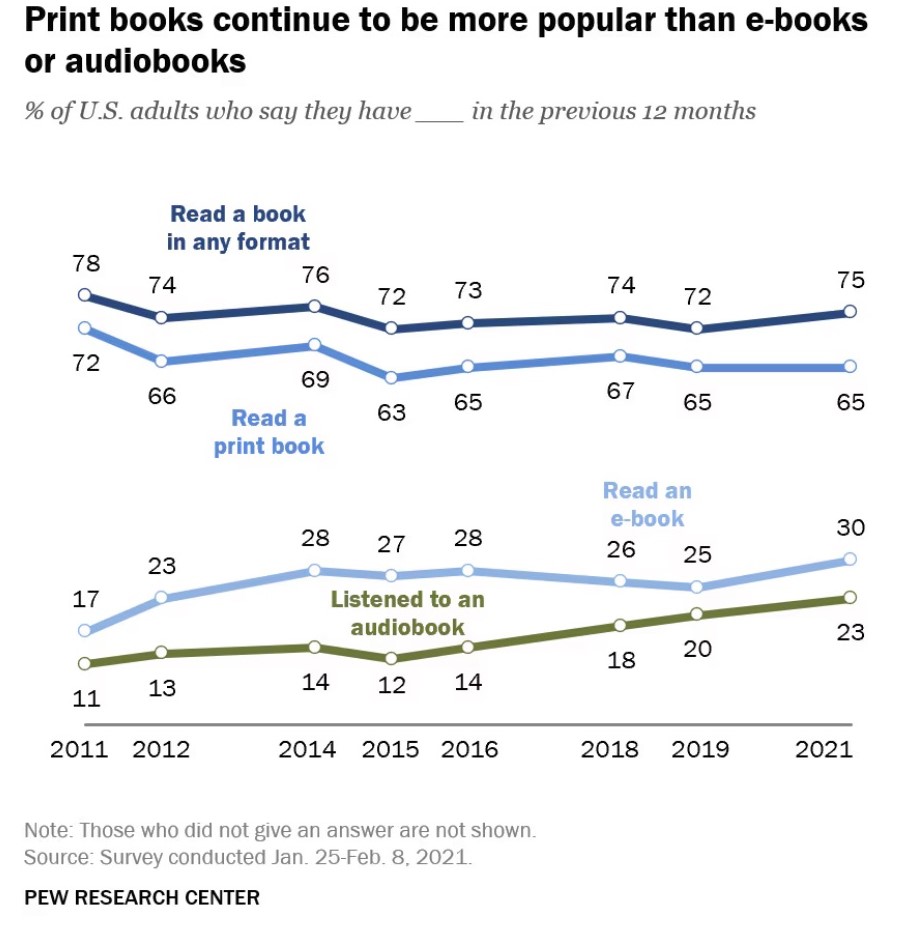
According to research from the Pew Research Center, print books remain the most popular format, outselling both eBooks and audiobooks (source WeForum). Despite the convenience of digital options, many readers still prefer the feel of a physical book in their hands.
Graph Credit: Pew Research Center
Final Thoughts: Which Book Format is Best
With so many options, there truly is a book format for everyone. Some readers love the convenience of audiobooks, others swear by their eReaders, and many (like me) still reach for a physical copy.
Personally, my first choice is a trade paperback. I love holding books, turning the pages, and watching my progress grow — there’s something deeply satisfying about seeing how far you’ve come. I love seeing books lined up on my shelves. And let’s be honest, a library with a ladder wouldn’t feel the same filled with eBooks. 😉
What about you? Do you have a go-to format, or does it depend on where (and how) you’re reading?
Join the daily conversation on my Facebook page or Instagram!



Leave a Reply to One-and-Done or Long-Haul? Stand-Alone Books vs. Series – Readers Gotta Read Cancel reply